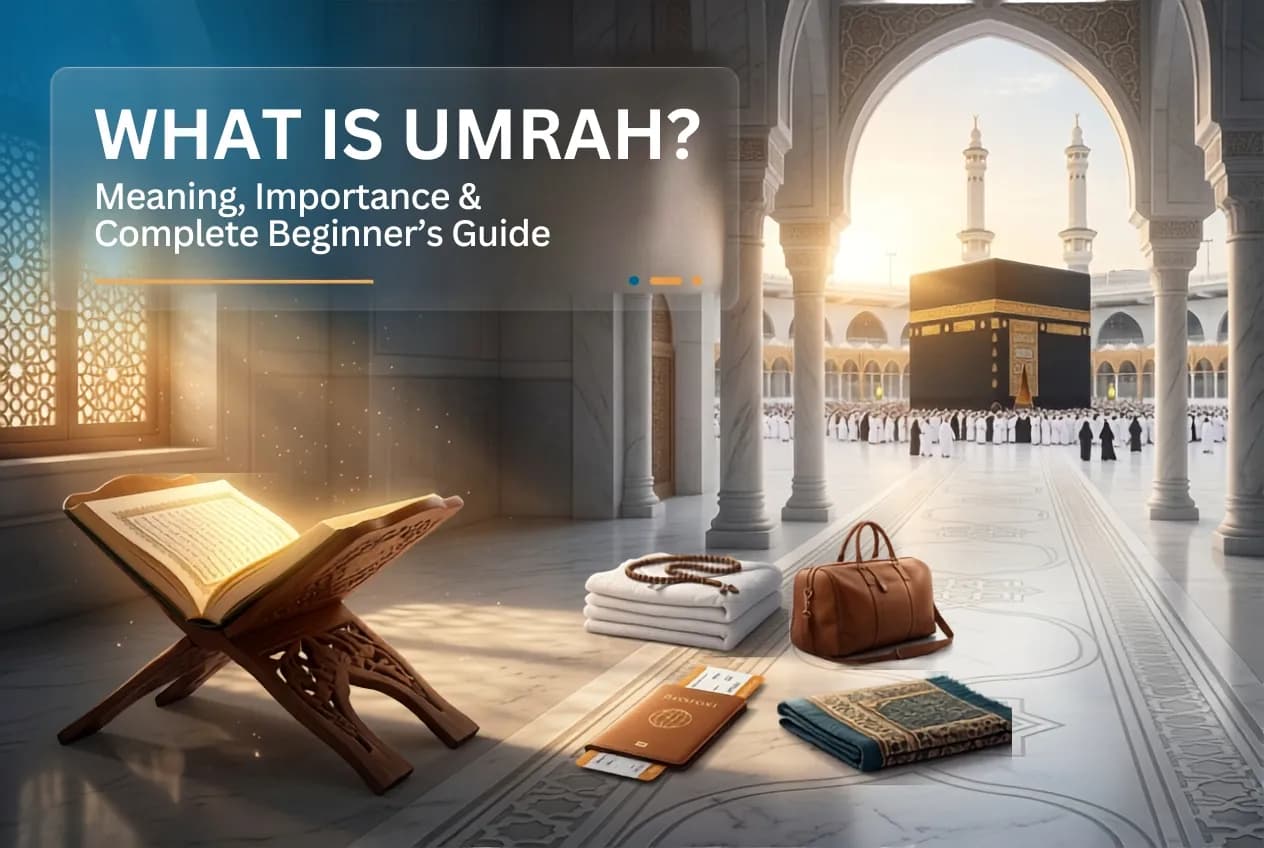
What Does "Umrah" Actually Mean?
The word Umrah comes from the Arabic root meaning "to visit" or "to populate" historically referring to a visit to a populated, inhabited place. In an Islamic context, Umrah refers to a pilgrimage to the Holy Kaaba in Makkah, performed by following a specific set of rituals.
Unlike Hajj, Umrah is often referred to as the "minor pilgrimage" not because it's less spiritually significant, but because it's shorter, simpler, and can be performed at almost any time of the year rather than during one fixed Islamic month.
The History Behind Umrah
Umrah's roots go back to a moment shortly after the Hijrah — the Prophet Muhammad's ﷺ migration from Makkah to Madinah. In a dream, he ﷺ saw himself and his companions entering Makkah in safety and performing the rituals of pilgrimage. Acting on this, the Muslims set out for Makkah in the 6th year after the Hijrah with the intention of performing Umrah.
They were stopped short of the city by the Quraysh, resulting in the Treaty of Hudaybiyyah — a peace agreement between the two sides. Under its terms, the Muslims returned to Madinah without completing the pilgrimage that year, but the following year, they returned and completed it peacefully. This became known as Umrat al-Qada, the "compensatory Umrah," and it fulfilled the vision from the Prophet's ﷺ dream.
This history is part of why Umrah carries such deep meaning for Muslims today — it's tied not just to ritual, but to a story of patience, faith, and eventual fulfilment.
Why Is Umrah Important in Islam?
Umrah holds deep spiritual significance for Muslims around the world. While it is not one of the Five Pillars of Islam (Hajj is), the Prophet Muhammad ﷺ described Umrah in terms that make its importance unmistakable.
Umrah removes sins between one Umrah and the next. The Prophet ﷺ said:
"From one Umrah to the next is an expiation for whatever sins come in between them, and an accepted Hajj has no reward other than Paradise." — Sahih al-Bukhari 1773, Sahih Muslim 1349
This hadith is one of the most frequently cited reasons Muslims return to perform Umrah again and again throughout their lives.
Pilgrims performing Umrah are considered guests of Allah. The Prophet ﷺ said:
"The pilgrims performing Hajj and Umrah are a delegation to Allah. If they call upon Him, He answers them; and if they ask Him for forgiveness, He forgives them." — Sunan Ibn Majah 2892
Umrah during Ramadan carries a reward equal to Hajj. The Prophet ﷺ said:
"Umrah during Ramadan is equal (in reward) to Hajj." — Sahih al-Bukhari 1863
This does not mean that Umrah replaces the obligation of Hajj, but it does highlight the extraordinary spiritual weight of Umrah — especially during Ramadan — which is why so many UK pilgrims choose to travel during this month through Ramadan Umrah packages.
For many Muslims, Umrah represents a chance to seek forgiveness, reset spiritually, and return to daily life with a renewed sense of purpose. Whether it is a first visit or a tenth, pilgrims consistently describe Umrah as one of the most transformative experiences of their lives.
Umrah vs Hajj: What's the Difference?
This is one of the most common questions first-time pilgrims ask us at Travels Hook.
| Aspect | Umrah | Hajj |
|---|---|---|
| Obligation | Highly recommended (Sunnah) | Obligatory once in a lifetime (if able) |
| Timing | Can be performed any time of year | Fixed dates in Dhul Hijjah only |
| Duration | Can be completed in a few hours | Takes several days |
| Rituals | Fewer, simpler steps | More extensive rituals |
In short: every Hajj includes elements of Umrah, but not every Umrah is a Hajj. Many pilgrims choose to perform Umrah multiple times throughout their lives, which is part of why it's grown so popular among UK Muslims booking flexible Umrah packages UK throughout the year.
Types of Umrah
Not every Umrah journey looks the same. Scholars generally categorise Umrah in a few different ways, based on timing and how it fits alongside Hajj.
By timing:
- Regular Umrah (Umrah Mufradah) — performed independently, at any point during the year, with no connection to Hajj season.
- Ramadan Umrah — widely considered the most spiritually rewarding time to perform Umrah. The Prophet ﷺ is reported to have said that Umrah performed during Ramadan carries a reward equal to that of Hajj — though it does not replace the obligation of Hajj itself.
- Rajab and Sha'ban Umrah — these two months, which lead up to Ramadan, are also considered spiritually significant, and many pilgrims choose to travel during this quieter period before the Ramadan rush.
By connection to Hajj:
- Standalone Umrah — performed on its own, entirely separate from the Hajj season, which is how most UK pilgrims experience it.
- Umrah as part of Hajj al-Tamattu — pilgrims perform Umrah first, exit the state of Ihram, then re-enter Ihram later for Hajj during the same trip.
- Umrah as part of Hajj al-Qiran — Umrah and Hajj are combined under a single, continuous state of Ihram.
For the vast majority of UK Muslims booking a trip through Travels Hook, it's the first category — a standalone Umrah — whether that's during Ramadan, December or any other time of year that suits their schedule.
What Do You Need for Umrah? (Visa, Documents & Vaccinations)
Before you travel, make sure you have the following in place:
- A valid passport with at least 6 months' validity remaining from your travel date
- An Umrah visa — this is arranged as part of your package when you book with a registered Umrah travel agency UK like Travels Hook
- Meningitis (ACWY) vaccination certificate — this is a mandatory Saudi entry requirement for all Umrah pilgrims
- Proof of accommodation and return travel, usually handled automatically within your package documents
- Ihram clothing, ready before departure (see packing list below)
Requirements can be updated by Saudi authorities from time to time, so always confirm the latest entry rules with your travel agent before booking flights independently.
The Basic Steps of Umrah
The Rituals of Umrah Explained in Detail
The four rites of Umrah follow a specific order. Understanding each one before you travel — what to do, what to say, and why it matters — will help you feel prepared and focused rather than confused on the day.
Step 1: Ihram — Entering the Sacred State
Ihram is not simply clothing — it is a sacred state of purity and intention that a pilgrim enters before crossing the Miqat (the boundary point).
Before entering Ihram, you should:
- Perform ghusl (a full ritual bath) or at minimum, make wudu
- Clip your nails, groom yourself, and attend to personal hygiene — once in Ihram, these things are not permitted
- Put on the Ihram garments: for men, two white unsewn sheets (one wrapped around the waist, one draped over the shoulder); for women, any clean, modest clothing that covers the body except the face and hands
At the Miqat, you should:
- Make your Niyyah (intention) for Umrah — either silently in your heart or spoken aloud: "Labbayk Allahumma bi-'Umrah" (Here I am, O Allah, for Umrah)
- Begin reciting the Talbiyah:
"Labbayk Allahumma labbayk. Labbayk la shareeka laka labbayk. Innal-hamda wan-ni'mata laka wal-mulk. La shareeka lak."
(Here I am, O Allah, here I am. Here I am, You have no partner, here I am. Surely all praise, grace and dominion are Yours, and You have no partner.)
The Talbiyah is recited repeatedly from this point until you begin Tawaf in Makkah.
What is the Miqat?
The Miqat is the designated boundary point beyond which a pilgrim cannot pass without being in the state of Ihram. There are five Miqat points surrounding Makkah. For UK pilgrims flying into Jeddah, the relevant Miqat is usually Yalamlam (also known as Al-Sa'diyyah) or the point where the pilot announces the Miqat over the aircraft intercom. Many pilgrims enter Ihram before boarding their flight or at the airport.
What is prohibited during Ihram?
Once in the state of Ihram, the following are not permitted:
- Cutting or trimming hair or nails
- Using scented soap, perfume, or any fragranced product
- Wearing stitched clothing (men only — women wear their normal modest clothing)
- Covering the head (men only)
- Covering the face or wearing gloves (women, according to most scholars)
- Intimate relations
- Hunting or harming living creatures
- Arguing, fighting, or using foul language
These restrictions are designed to strip away distractions and focus the pilgrim entirely on worship.
Step 2: Tawaf — Circling the Kaaba
Upon arrival at Masjid al-Haram in Makkah, the pilgrim proceeds to perform Tawaf — walking seven complete circuits around the Kaaba in an anti-clockwise direction.
How to perform Tawaf:
- Enter the Masjid with your right foot, making dua for entering the mosque
- Locate the Hajr al-Aswad (Black Stone) — this is the starting point
- If possible, touch or kiss the Black Stone. If the area is crowded (which it usually is), simply face it, raise your right hand, and say "Bismillahi Wallahu Akbar" (In the name of Allah, Allah is the Greatest)
- Walk anti-clockwise, keeping the Kaaba to your left
- Men should perform Idtiba (uncovering the right shoulder) throughout Tawaf, and Raml (walking briskly) during the first three circuits
- There is no single fixed dua for Tawaf — you may make any personal supplication, recite Quran, or engage in dhikr
- Complete seven full circuits, ending at the Black Stone
After completing Tawaf:
- Offer two raka'at of prayer behind Maqam Ibrahim (the Station of Ibrahim) if space allows — otherwise, anywhere within the Haram
- Drink Zamzam water, which is freely available throughout the mosque
Step 3: Sa'i — Walking Between Safa and Marwah
Sa'i involves walking seven times between the two small hills of Safa and Marwah, located within the Masjid al-Haram complex.
The story behind Sa'i:
This ritual commemorates Hajar (may Allah be pleased with her), the wife of Prophet Ibrahim (AS), who ran between these two hills seven times searching for water for her infant son Isma'il (AS). Allah answered her desperate prayer by causing the well of Zamzam to spring from the ground — a well that continues to provide water to millions of pilgrims today.
How to perform Sa'i:
- Begin at Safa. Climb the hill (or reach the marked area), face the Kaaba, raise your hands, and make dua
- Walk towards Marwah. Between the two green fluorescent markers, men should walk briskly (this section marks the valley where Hajar ran). Women walk at their normal pace throughout
- Reaching Marwah completes one lap. Turn around, face the Kaaba, make dua, and walk back to Safa — this completes the second lap
- Continue until you have completed seven laps in total (finishing at Marwah)
Throughout Sa'i, you may make any personal dua, recite Quran, or engage in dhikr.
Step 4: Halq or Taqsir — Shaving or Trimming the Hair
The final step of Umrah is cutting the hair, which symbolises the completion of the pilgrimage and the exit from the state of Ihram.
- Halq (shaving the head completely) — this is for men and is considered the more virtuous option. The Prophet ﷺ made dua three times for those who shave their heads, and only once for those who trim
- Taqsir (trimming the hair by at least a fingertip's length from all sides) — this is the alternative for men, and the standard option for women. Women should never shave their heads for Umrah
After Halq or Taqsir, you are released from the state of Ihram. All the restrictions that were in place — scented products, stitched clothing, and so on — are now lifted. Your Umrah is complete.
How to Prepare Spiritually Before Umrah
Physical and logistical preparation — flights, visas, packing — are essential. But spiritual preparation is equally important and is often overlooked by first-time pilgrims.
Make sincere repentance (Tawbah). Before departing, ask Allah sincerely for forgiveness for past sins. Umrah is a journey of spiritual renewal, and entering it with a clean heart amplifies its impact.
Settle debts and resolve disputes. If you owe money to anyone, make arrangements to repay it or seek their agreement before you travel. If you have unresolved disagreements with family, friends, or colleagues, try to resolve them or at least seek forgiveness. The Prophet ﷺ emphasised the importance of clearing personal obligations before worship.
Learn the rituals in advance. Do not arrive in Makkah unfamiliar with what Tawaf, Sa'i, and Ihram involve. Read this guide thoroughly, watch reputable video walkthroughs, and learn the key duas — particularly the Talbiyah, the dua for entering the mosque, and the dua between the Yemeni Corner and the Black Stone during Tawaf:
"Rabbana atina fid-dunya hasanatan wa fil-akhirati hasanatan wa qina 'adhab an-nar."
(Our Lord, give us good in this world and good in the Hereafter, and protect us from the punishment of the Fire.) — Quran 2:201
Write a personal dua list. Many pilgrims describe the moments during Tawaf and at Safa and Marwah as some of the most powerful spiritual moments they have experienced. Have your personal supplications ready — for yourself, your family, and anyone who has asked you to make dua for them.
Disconnect from distractions. The days of Umrah are short and precious. Plan to limit your phone use, avoid unnecessary socialising, and focus entirely on worship during the rituals.
The Nusuk App and Saudi Umrah Permits (2026)
Since 2024, Saudi Arabia requires all Umrah pilgrims to register through the official Nusuk platform (nusuk.sa) to obtain an Umrah permit. This permit is separate from the Umrah visa and is required to enter Masjid al-Haram for the purpose of performing Umrah.
When you book through a licensed UK Umrah travel agency like Travels Hook, the Nusuk registration is handled as part of your package. However, if you are arranging your trip independently, you will need to:
- Create an account on the Nusuk app or website
- Register your passport and travel details
- Book your Umrah permit for a specific date
It is important to note that Umrah permits via Nusuk are typically suspended during the Hajj season (approximately Shawwal to the end of Dhul Hijjah) and resume after Hajj concludes. Always check the current status before booking your flights.
Who Can Perform Umrah?
Umrah can be performed by any Muslim who is physically able to travel, regardless of age. That said, some practical considerations matter:
- First-time pilgrims often benefit from a guided package with clear instructions at every step
- Elderly travellers may prefer hotels closer to the Haram to reduce walking distances something our team factors into every luxury Umrah package
- Families travelling with children often find it easier to book a coordinated families rather than arranging everything separately
- Solo Travellers on a tighter budget often start with one of our affordable Umrah packages

How Much Does Umrah Cost from the UK? (2026 Prices)
The cost of Umrah from the UK depends on your travel dates, hotel distance from the Haram, and how long you plan to stay. As a rough guide:
- Budget Umrah packages: From around £700–£1,200 per person, ideal for solo travellers or those on a tighter budget — see our affordable Umrah packages
- Standard Umrah packages: Typically £1,200–£2,000 per person, including 3–4 star hotels within walking distance of the Haram
- Luxury Umrah packages: £2,500 and above, with 5-star hotels overlooking the Haram — explore our luxury Umrah packages
Prices tend to rise during Ramadan and December due to high demand, so booking early for these periods is worth it if you're considering our Ramadan Umrah packages or December Umrah packages. Travelling outside peak season is usually the most cost-effective option.
Every quote from Travels Hook includes flights, visa, accommodation, and transport, so there are no hidden surprises — get a personalised quote based on your dates and budget.
When Is the Best Time to Perform Umrah?
Because Umrah isn't tied to a fixed date, pilgrims from the UK have flexibility most of the year. That said, a few periods are worth knowing about:
- Ramadan: Considered spiritually significant by many scholars, and extremely popular book early if you're considering Ramadan Umrah packages
- December: A popular choice for UK families due to school holidays see our December Umrah packages
How Travels Hook Can Help First-Time Pilgrims
Planning your first Umrah can feel overwhelming, but it doesn't need to be. As an ATOL protected Umrah travel agency UK pilgrims trust, Travels Hook takes care of the practical side of your journey flights, visas, accommodation, and transport so you can focus on the spiritual purpose of your trip.
Whether you're comparing Umrah deals UK, looking specifically for Hajj and Umrah packages UK, or simply want an honest recommendation based on your budget and travel dates, our team is here to guide you — not just sell you a package.
What to Pack for Umrah: A Simple Checklist
- Ihram garments — two seamless white sheets for men; modest, loose clothing for women
- Comfortable, easy-to-remove sandals for frequent wudu and mosque visits
- Unscented toiletries — scented products are not permitted while in the state of Ihram
- A small prayer mat and tasbih (prayer beads)
- Copies of your passport, visa, and vaccination certificate, kept separately from the originals
- A money belt or pouch for cash and cards
- A portable charger and UK-to-Saudi plug adapter
- Basic medication, along with prescription copies for anything you take regularly
A Note on Health & Fitness Before You Travel
Tawaf and Sa'i involve several kilometres of walking, often in warm conditions, so it helps to:
- Build up your walking stamina in the weeks before travel
- Stay well-hydrated throughout the trip, especially outside the winter months
- Speak to your GP before travelling if you have a health condition, are elderly, or are travelling with young children
- Pack any regular medication with enough supply for the full trip
